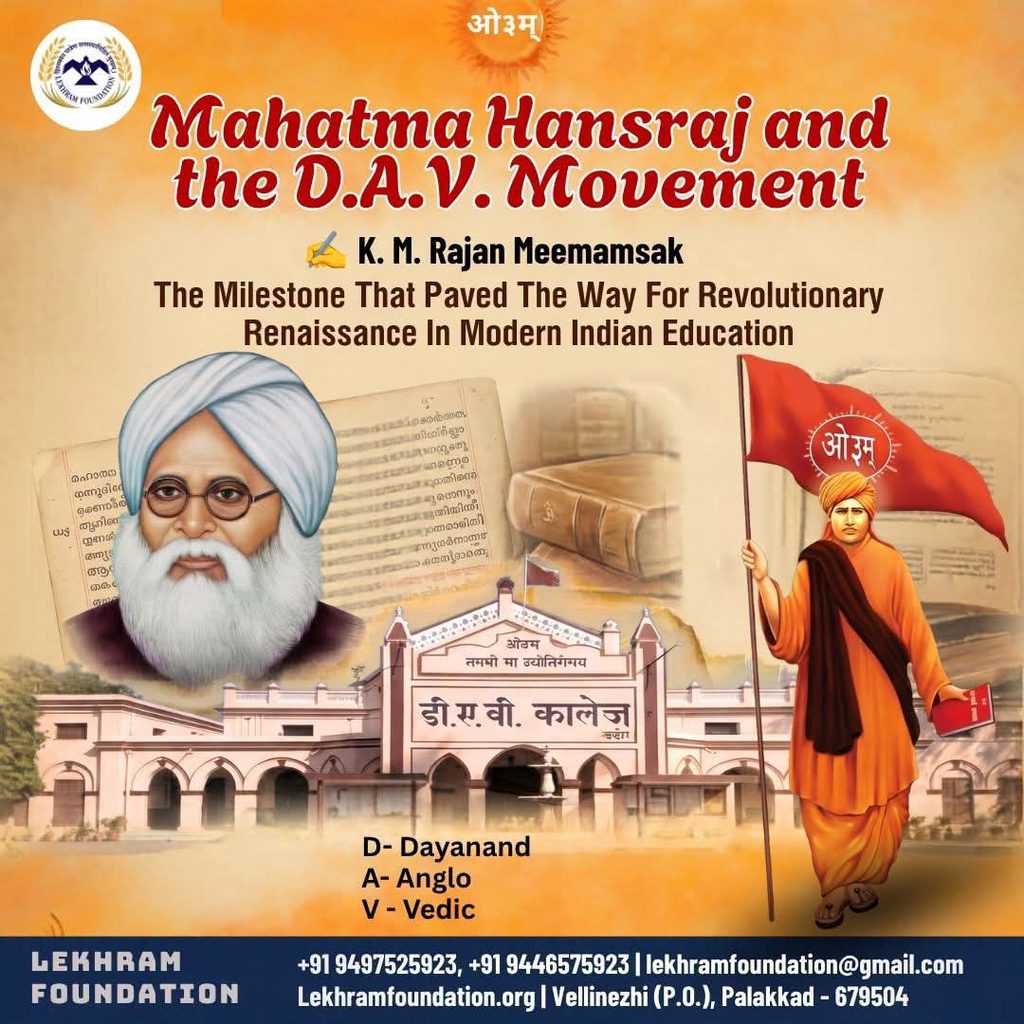
K. M. Rajan Meemamsak
The establishment of the Dayanand Anglo-Vedic College (DAV) in Lahore under the leadership of the Arya Samaj marked a significant milestone in the educational renaissance of modern India. The DAV Movement and the vision of Vedic education championed by Mahatma Hansraj, who played a leading role in it, made remarkable contributions to inspiring the Indian freedom struggle.
Mahatma Hansraj (1864–1938) was a distinguished educationist and social reformer associated with the Arya Samaj movement. He played a decisive role in the establishment and growth of the Dayanand Anglo-Vedic (DAV) educational movement, which aimed to integrate Vedic knowledge with modern scientific and English education.
The ideas of Maharshi Dayanand Saraswati (1824–1883) served as the inspiration behind this educational movement. Maharshi Dayanand, who founded the Arya Samaj in 1875, had presented a clear vision of education.
He wanted education to achieve the following objectives:
- To promote Vedic knowledge and the pursuit of truth.
- To develop scientific thinking and rational inquiry.
- To cultivate moral character and a disciplined way of life.
- To ensure equality and social welfare.
- To facilitate the intellectual and social upliftment of all sections of society.
Mahatma Hansraj gave an organised institutional shape to these ideas through educational initiatives.
Early Life of Mahatma Hansraj
Mahatma Hansraj was born on 19 April 1864 in Bajwara, a place in the Punjab region.
He received his education during the period of British rule, when modern Western education was beginning to exert its influence on Indian society.
Inspired by the ideals of Maharshi Dayanand, he joined the Arya Samaj and dedicated his life to educational and social service.
He believed that education was not merely a means of securing employment but a way of creating citizens equipped with knowledge, moral values and a sense of responsibility.
Establishment of the DAV Movement
Following the passing away of Maharshi Dayanand Saraswati in 1883, his followers decided to establish institutions that would preserve and carry forward the memory and ideals of the great Rishi.
As part of this initiative, the Dayanand Anglo-Vedic School was established in Lahore on 1 June 1886.
Mahatma Hansraj assumed charge as its first Headmaster. He rendered his services without accepting any remuneration.
Later, when the DAV College was established in Lahore in 1889, he became its first Principal.
The educational system of this institution was based on the integration of two traditions of knowledge.
The components of DAV stand for:
- D – Dayanand: Inspired by the ideals of Maharshi Dayanand Saraswati.
- A – Anglo: Modern English and Western scientific education.
- V – Vedic: Vedic knowledge, Indian philosophy and moral values.
Thus, it represented a synthesis of the following fields of knowledge:
- Vedic Education
- Sanskrit
- Vedic literature
- Indian philosophy
- Moral education
- Life values
- Modern Education
- English
- Mathematics
- Sciences
- History
- Modern branches of knowledge
This integrated educational system later became the foundation of the DAV Movement.
Mahatma Hansraj’s Sacrifice and Dedication to Service
One of the most remarkable features of Mahatma Hansraj’s life was his spirit of selfless service.
He dedicated his life to the activities of the Arya Samaj, the promotion of education and social service.
His Connection with Kerala
When the Moplah Rebellion broke out in Malabar region of Kerala in 1921, under the leadership of Mahatma Hansraj, who was then the President of the Arya Pratinidhi Sabha for Punjab, Sindh and Baluchistan, sent several dedicated Arya Samaj missionaries to Kerala to undertake relief activities.
Among them were Vedabandhu Sharma, a Malayali who had completed his education at DAV College, Pandit Rishiram and Khushalchand Khursand, who later became known as Mahatma Anand Swami.
The highly courageous relief activities carried out under their leadership in Malabar, along with their heroic efforts to bring back into the fold of Sanatana Dharma thousands of Hindus who had been forcibly converted to Islam under the threat of the sword, have largely remained unrecorded in our history books.
However, these missionaries sent a detailed report of their experiences and activities to Mahatma Hansraj.
This report was published in 1923 as a Hindi book titled 1921: Arya Samaj Aur Malabar.
On the occasion of the centenary of the Moplah Rebellion, the author of this article translated the book into Malayalam and English, and Arya Samajam Vellinezhi published the translations.
The life of Mahatma Hansraj, who provided leadership and inspiration for such service activities, remains an outstanding example of selfless dedication.
He believed that personal sacrifice and commitment were essential for the progress of society.
His contribution was not limited to establishing an educational institution. He laid the foundation for an educational tradition capable of being carried forward through generations.
Educational Philosophy of the DAV Movement
The objective of the DAV Movement was to integrate India’s ancient educational traditions with the knowledge and advancements of the modern world.
This educational philosophy was primarily based on the following principles:
- Integration of Ancient and Modern Knowledge
Along with Vedic and Sanskrit education, modern subjects such as science, mathematics and English were to be taught.
- Character Formation
To cultivate honesty, discipline, courage, a sense of responsibility and a spirit of service.
- Universal Education
To ensure access to education for everyone without discrimination based on caste or social background.
- Women’s Education
To encourage women’s education and their participation in society. - National Renaissance
*
To develop self-confidence, cultural awareness and a sense of responsibility towards the nation.
These ideals transformed DAV institutions into important centres of education and social reform.
Growth of the DAV Movement
The DAV Movement, which began in Lahore, gradually spread to various parts of India. Numerous schools, colleges and other educational institutions were established.
The Post-Independence Period
Even after the Partition of India, the DAV Movement continued to expand under the leadership of Arya Samaj missionaries and educationists.
DAV institutions made significant contributions to various fields, including arts, science, commerce, technology, professional education and Vedic research.
The movement remained closely associated with the social reform activities of the Arya Samaj and the efforts towards national renaissance.
The DAV Movement was never confined merely to academic education. It also contributed significantly to the social and intellectual renaissance of India.
Inspired by the DAV Movement, several educational institutions continue to function in different parts of the country under various names.
Many prominent personalities who worked within the sphere of influence of the Arya Samaj and the broader DAV tradition made significant contributions to the national life of India.
Among them were Pandit Gurudatta Vidyarthi and Lala Lajpat Rai, who maintained close associations with the Arya Samaj and the national movement.
Besides them, several brave patriots and revolutionaries, including Bhai Parmanand, Bhagat Singh, Rajguru, Sukhdev, Premdatta Varma, Raghunath Sahai, Comrade Dhanwantri and Pran Nath Puri, had close connections with the Arya Samaj and the DAV Movement.
A large number of freedom fighters associated with the revolutionary Ghadar Movement were also inspired by the Arya Samaj and DAV institutions. Revolutionaries such as Bhai Parmanand also served as teachers at DAV College.
Mahatma Hansraj’s major contributions were in the fields of education and social service. He successfully transformed the ideals of Maharshi Dayanand into an organised educational programme.
Mahatma Hansraj passed away on 14 November 1938. However, the educational tradition he helped establish continues to flourish through numerous institutions known by the name DAV.
Hansraj College, under the University of Delhi, was also named in his honour. His life teaches us a valuable lesson, the ideas of a great reformer acquire lasting significance when dedicated individuals translate them into institutions and carry them forward through generations.
His historic contribution lies in providing a strong educational foundation for the vision of Maharshi Dayanand and ensuring that it reached future generations.
Relevance of the DAV Movement in the Present Era
Even in today’s educational environment, the fundamental philosophy of the DAV Movement remains highly relevant.
A comprehensive system of education must develop three dimensions of human personality.
- Intellectual Development
To promote scientific knowledge, critical thinking and a spirit of research.
- Moral Development
*
To cultivate honesty, discipline, compassion, sincerity and a sense of responsibility.
- Spiritual Development
To develop self-knowledge, a righteous way of life and an awareness of Vedic knowledge.
By embracing the educational vision of Maharshi Dayanand and the exemplary spirit of service demonstrated by Mahatma Hansraj, the DAV Movement can continue to make significant contributions to society.
Maharshi Dayanand Saraswati provided the philosophical foundation for Vedic, social and educational reforms. Mahatma Hansraj gave institutional form to that vision.
If Maharshi Dayanand was the visionary behind this movement, Mahatma Hansraj was one of its principal architects.
Therefore, the history of DAV is not merely the history of an educational movement. It is also an important chapter in the history of India’s educational renaissance, social reform and national awakening.
The most fitting tribute to Mahatma Hansraj is to carry forward his ideals.
The Relevance of this DAV Legacy to the New Educational Initiative in Kerala
May the Vedic vision of Maharshi Dayanand Saraswati and the educational dedication of Mahatma Hansraj inspire a new educational initiative in Kerala.
May the objective of this new educational venture be:
“To create ideal citizens by remaining rooted in Vedic wisdom, growing through modern knowledge and developing through moral values.”
Education is not merely a means of acquiring knowledge; it is a means of making human beings better and leading society towards higher ideals.
🙏
K. M. Rajan Meemamsak
Arya Samaj Pracharak & Adhishtatha Karalmanna Veda Gurukulam & Lekhram Kanya Gurukulam, Vellinezhi
Mob: 7907077891
Email: kmrajanmeemamsak@gmail.com